
Why do children collect things?
With expert input from educational psychologist, Dr Ahmar Ferguson

The Freelance Parent is a newsletter aimed at helping its subscribers thrive professionally and personally. If you find this week’s issue helpful, please consider becoming a paid subscriber for just £4 a month (the price of a coffee). Your support will help me create more great content for you and paid subscriber benefits. It would mean the world if you did.
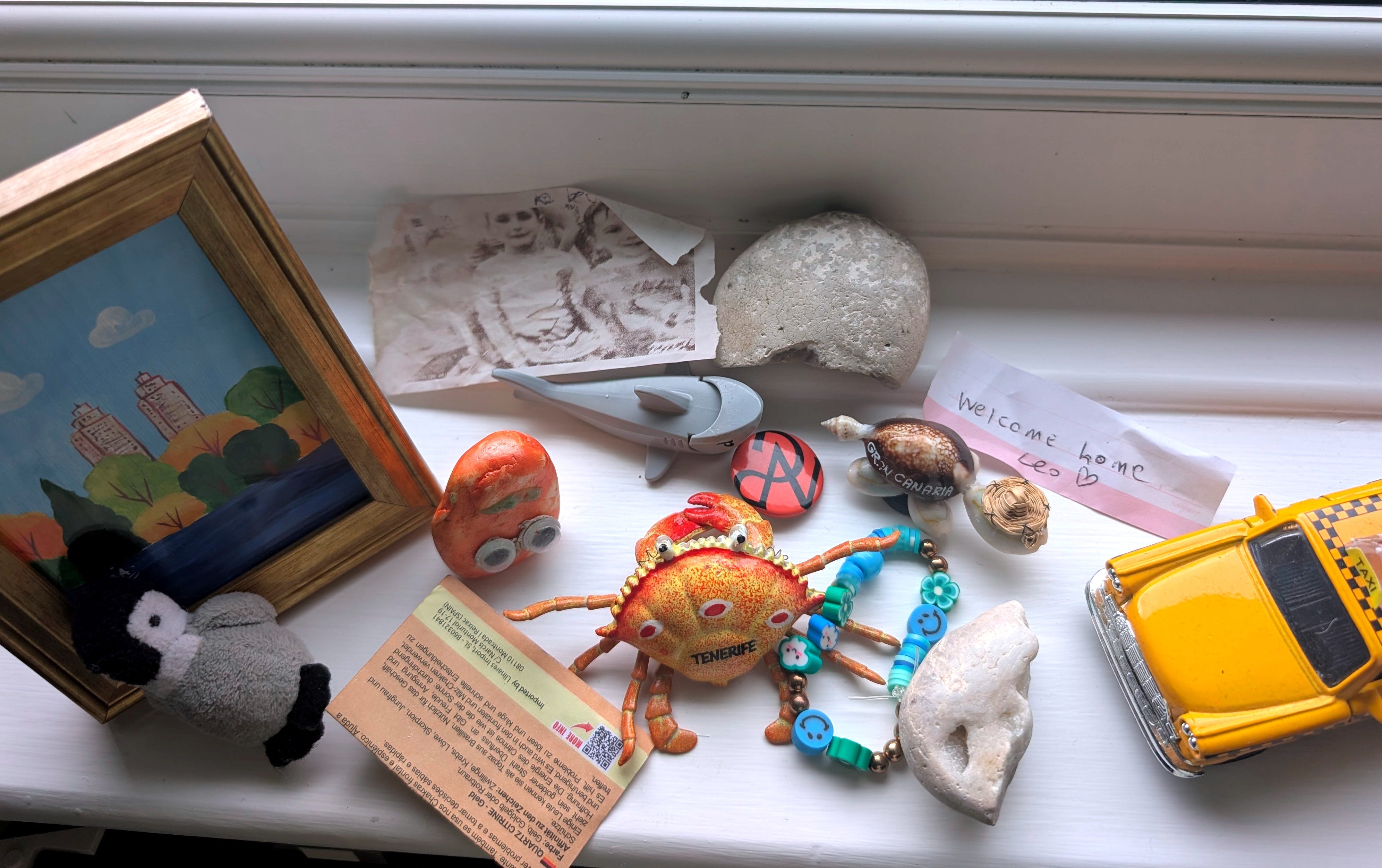
My eldest son is nearly 8 and he is a collector. The drawers beneath his bed are jam-packed full of tiny figures, tickets, broken bits of old toys, shells, trinkets and drawings. Oh, so many drawings.
Last week while making his bed and tidying his many things, I felt quite grumpy. It was in the midst of the heatwave, and my urge for everything to be as tidy as possible was not being met. I was thinking of the dust beneath his bed, and the need to tell him off for holding on to SO MANY THINGS.
But then I started to pay attention.
There was a handwritten note he had given his brother many months ago. A yellow taxi cab I had bought him as a gift after visiting a friend in New York. Tiny shells he’d carried home in salty buckets from long, sunny days at the beach, and even crafts he’d made at kids clubs on a holiday in Tenerife two years ago. He once told me that the paper guitar he had made in said kid’s club made him want to cry because it had been such a good day.
“OK so this one stays in the memory box then?” I remember replying.
The small flamingo that sits on his windowsill was picked up on a trip to a zoo with good friends we don’t see that often, and the small stuffed seal - that I can never get to stand up - was procured on a hot day trip to Kew Gardens when my youngest son was just a baby. I was struggling to split my attention between a needy newborn and a jealous toddler and I was trying to make the day special. While stress and heat is my core memory of this small stuffed object, it obviously means something different to him.
While tidying his room, it dawned on me that most of the tiny objects that he spreads along his windowsill, and stores in boxes and drawers, are attached to happy memories and feelings. Times, I hope, that he felt loved, appreciated and happy.
His memory box is also full to the brim of the items he considers to be the most precious. Tickets, notes and cards from his christening and first birthday, holiday bracelets and alike. Top tier trinkets attached to the very happiest and special of memories. He asks every so often for me to take it down, from the top of the wardrobe where it lives, so I can describe, once again, the origin behind every single thing.
My own Treasure Box from childhood, as I called it, is tucked away upstairs full to the brim of letters from school friends, notes from pen friends (I had lots around the world), special trinkets, broken jewellery and alike. I don’t look at it often but when I do, I’m transported right back to a memory I would otherwise have forgotten. I also have about 20 diaries that I started writing from around age five up until 19. My children and grandchildren will have fun with those one day, I’m sure. And I wonder where he gets his sentimentality from.
While my adult tendency towards tidy makes my son’s collections sometimes seem chaotic and messy, in his eyes, he has everything he wants where he wants it. And that, it seems, brings him immense comfort.
But why do children collect things and what is the psychological reason for it? Educational psychologist Dr Ahmar Ferguson says that children often collect things because collecting gives them a sense of order, ownership and meaning. “A collection might look random to adults, a handful of stones, shells, stickers, conkers, bottle tops, but to the child each item can feel significant,” he explains. “It may represent a place they visited, a moment they enjoyed, a person they were with, or simply something that caught their attention and felt special.”
He adds that collecting can also be part of how children make sense of the world. It allows them to notice patterns, sort objects, compare similarities and differences, and create categories - something that would explain why we have many different types of grey rocks.
“That might be by colour, size, shape, texture or where the object came from,” he says. “In that sense, collecting is not just sentimental, it can be cognitive too. It supports curiosity, memory, language and a developing sense of identity.”
But, I learned, there is also an emotional element, too. “Children often attach meaning to physical objects in a way adults can underestimate,” Dr Ferguson adds. “A shell from a beach trip may not just be a shell, it may be a way of holding on to the feeling of that day. For younger children especially, objects can help make memories more concrete. They become little anchors to experiences, relationships and emotions.”
This definitely explains the extreme reaction my son has had in the past after I’ve tried to clear a few things away without him noticing. (He always notices). So what can we do as parents to respect this very normal childhood process while keeping things from getting out of hand?
“As parents, the key is to respect the meaning without allowing the collection to take over the house,” Dr Ferguson tells me. “I would avoid dismissing it as “rubbish” or throwing things away without involving the child, because that can feel quite personal to them. Instead, you can create gentle boundaries. For example, ‘You can keep your favourite ten shells in this box,’ or ‘Let’s choose the ones that feel most special and take a photo of the others before we let them go.’”
He suggests giving them a memory box, a small display shelf, scrapbook or labelled jar to store them and keep them safe. This also lets the rest of the family know not to get rid of them. “It gives the collection a home and helps the child feel that their interests are being taken seriously. You can also make sorting through the collection part of the process: ‘Which ones do you want to keep? Which ones remind you of something? Which ones can we pass on, return to the garden, or photograph?’,” Dr Ferguson suggests.
This, he says, helps children learn that memories can be honoured without needing to keep everything. “It also supports decision-making, emotional regulation and letting go, but in a way that feels collaborative rather than controlling.”
Dr Ferguson reassures that if you also have a collector in the house, remember that it is giving them a way to organise their world, express their interests and hold on to moments that matter. “The adult role is to provide boundaries with warmth, rather than shutting the behaviour down completely.”
Often as adults we can forget to see things as a child again, but this is one small habit that I’ll definitely view differently from now on.
Does your child also collect things and do you have any tips for keeping things organised but accessible? Drop me a comment below. I’d love to hear your tales of sentimentality.
Until next time,
Cat x
The Freelance Parent is a newsletter aimed at helping its subscribers thrive professionally and personally. If you find this week’s issue helpful, please consider becoming a paid subscriber for just £4 a month (the price of a coffee). Your support will help me create more great content for you and paid subscriber benefits. It would mean the world if you did.